
At Partnership for Safety and Justice, we work toward an Oregon where public safety solutions advance racial equity, accountability, and healing. Central to our mission is helping Oregonians envision and build a future where we invest in communities, not prisons.
Making our shared vision real requires more than identifying what must change. We also need to understand how change happens: where decisions are made, who has the authority to act, and how communities can hold public institutions accountable. By elevating practical solutions and the leadership of people directly impacted by the criminal justice system, we can turn a different vision for public safety into meaningful, community-led change.
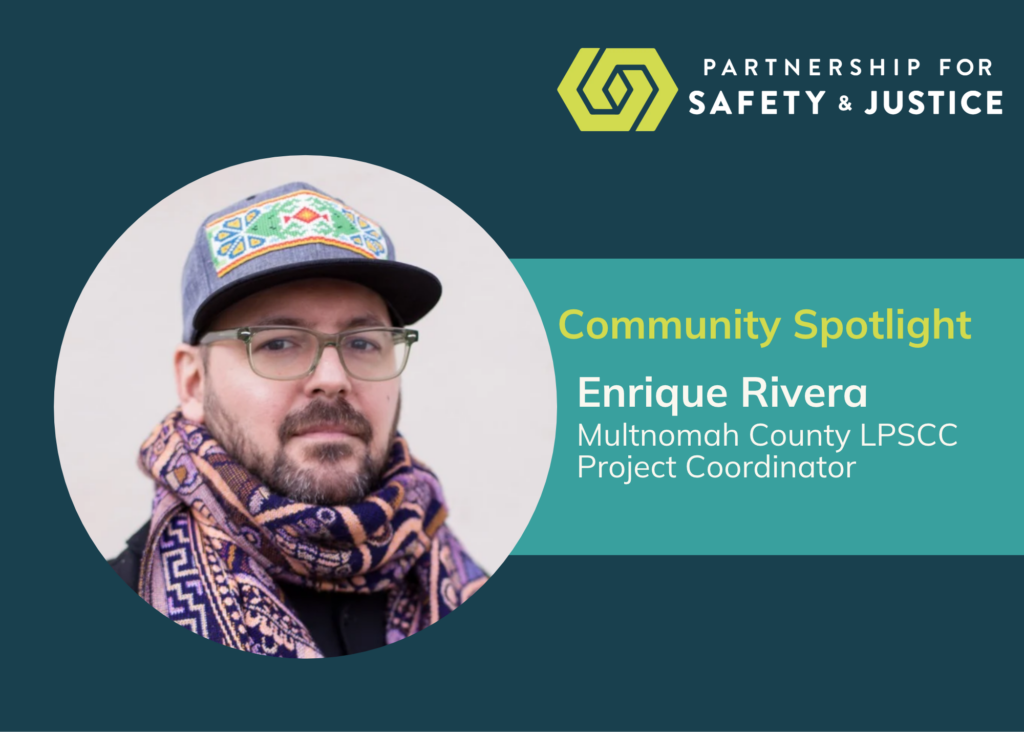
Enrique Rivera’s journey illustrates the power of bringing lived experience into the places where public safety decisions are made. After entering the justice system as a child, he built a career helping directly impacted people understand that system, connect with decisionmakers, and shape the policies affecting their communities. We spoke with Enrique, the Justice Fellowship Program Coordinator for Multnomah County’s Local Public Safety Coordinating Council (LPSCC), about his path from system involvement to public safety leadership—and why lived experience is essential to building communities, not prisons.
Read on to learn how Enrique draws from his personal experience with incarceration to advance public safety solutions, shift institutional culture, and build alternative safety models grounded in community wisdom.
The Consequences of Racialized Gang Labeling
Enrique first entered the justice system at age 12. “My first probation case began when a caller saw three young Latino boys and described us as ‘Mexican kids doing gang graffiti,’ and interpreted our clothing and presence through a gang lens.” He was only looking at the graffiti.
When police arrived, his friend, the friend who had made the graffiti, took full responsibility, but officers treated all three as responsible because they were together.
Racialized gang labeling can have lasting consequences. “Once the label enters a record, it can follow someone even when it was based on association, appearance, clothing, or racialized assumptions rather than actual gang membership,” Enrique says. In jurisdictions with gang enhancements or injunctions, that designation can also result in a longer sentence.
Enrique was charged and placed on probation. What began as a trip to look at a friend’s graffiti escalated into community service, probation violations, and repeated detention.
By 17, after becoming increasingly involved in a harmful lifestyle, he participated in a shooting and received a Measure 11 sentence. He spent approximately eight months in Marion County Jail before serving the remainder of his sentence at MacLaren Youth Correctional Facility.
Finding a Path Forward through Education
At MacLaren Youth Correctional Facility, Enrique earned his high school diploma and began college. By the time he was released, he was close to earning an associate degree, and moved to Portland to start a new chapter.
With support from the Multnomah County Library, Enrique enrolled at Portland Community College, learned to use a computer, and continued his coursework. He eventually transferred to Portland State University, spent his final year abroad, and graduated from college.
Shifting the Dominant Culture of Public Safety Systems
After nearly 13 years at the Multnomah County Library, where he conducted outreach to Spanish-speaking communities and people in correctional facilities, Enrique moved into public safety work with Multnomah County’s Local Public Safety Coordinating Council (LPSCC).
Since 1995, each county has had its own LPSCC to coordinate policies and operations and collectively address issues critical to public safety.
Multnomah County’s LPSCC brings together representatives from the jail and sheriff’s office; the district attorney’s office; the public defenders’ office; the courts; city and county commissioners; and community members to discuss pressing safety issues and advise the County Board of Commissioners.
The council also directs the work of subcommittees and smaller workgroups focusing on emerging issues within the justice system, such as Current subcommittees: Justice Reinvestment Steering Committee and Juvenile Justice Steering Committee; Workgroups: Detention Capacity and Restorative Justice, Youth Violence Prevention, Law Enforcement Agency Alignment, Pretrial Supervision, and Mental Health Services.
Equipping Community Leaders to Drive Change
As part of his role, Enrique organizes the Multnomah County Justice Fellowship, a four-month civic engagement and leadership development program for people with experience across the criminal justice system, including pretrial proceedings, incarceration, and post-prison supervision. As he states, “People who have moved through the system understand it in ways others cannot.” That’s why people with lived experience must inform policy and practice.
Through this fellowship, participants meet representatives from the courts, public defense, the district attorney, the County’s Department of Community Justice, law enforcement, advocates, and other system partners. “We help participants understand who makes which decisions, build relationships, and apply their expertise to real projects and governing bodies,” says Enrique.
As Enrique explains, the fellowship gives people who have often been excluded or “left behind” a map of the system, relationships with decision-makers, and clarity about rights and opportunities.
Effective public safety solutions must be shaped by the people most directly affected by the criminal justice system. By equipping community leaders with the institutional knowledge, relationships and opportunities needed to influence decision-making, Enrique is helping transform lived experience into power and challenging the status quo from within.
###
At PSJ, our work is guided by people with lived experience. By sharing stories of community members developing real solutions to crime and violence, we can show how Oregonians are already creating safety, accountability and healing—and invite more people to join us in building communities, not prisons.